

The ARRIVE trial was a study published in 2018, which considered early induction of labour (at 39 weeks) for healthy women.
While some doctors use the study to promote induction, because the study found a lower rate of caesareans in the induction group, there are some significant concerns about the study, which did not show that induction improved outcomes for babies.
This blog post explains those concerns, and the many criticisms that have been made about the ARRIVE Trial.
There are now so many papers, blog posts, and studies criticising this trial that I have turned this into a bit of an overview, which will signpost you to many of the other sources of information online, as well as those that I have written.
What was the ARRIVE Trial?
The ARRIVE Trial (Grobman et al 2019) was a multi-site, randomised controlled trial whose authors wanted to find out whether induction of labour or expectant management was better in terms of
(a) adverse perinatal (mother and baby) outcomes, and
(b) the risk of cesarean birth among healthy women having their first baby at 39 weeks of pregnancy.
One really important fact to know from the outset is that the trial did NOT show that induction was safer for babies. The primary outcome, which was adverse neonatal outcomes, was not significantly different between the two groups.
The trial did show that cesareans were more likely in the women who didn’t have their labour induced. This result is very questionable, for several reasons, as I will explain further below. But to save you wondering, the main issue is that caesareans aren’t the kind of outcome that just happens. They happens as the result of a human decision, and obstetricians who favour intervention may be more likely to want to do an earlier caesarean in a woman whose labour isn’t being induced. So this outcome reflects the beliefs of the obstetricians in the trial, not what would happens in the real world. More on this below.
Reception and Critique
Even before the results of the ARRIVE Trial were published, many people had concerns about it. Some of these concerns – for instance the fact that the trial’s population was very specific, which means the results only apply to a narrow group of women – have been cited in the many critiques that exist of this trial.
And yet, despite the concerns and critiques, the trial’s findings are often quoted to women as part of an argument that they should have induction of labour.
This is really concerning. It’s not clear whether those who cite the trial are unable to understand the critiques, are closed-minded to the wider evidence, and/or are deliberately misusing the trial results, but the net result is that women and families are not being given full and honest information about this area.
ARRIVE versus real world data
There are a number of problems with the ARRIVE Trial, and a number of people, including myself, have written about these in depth.
For instance, I’ve written about how real world data on the chance of having a caesarean after an induction conflicts with the results of the ARRIVE Trial, which implies that these results are questionable.
I’ve explained my concerns about how caesarean rates are influenced by professional’s beliefs in two of my books, and also in this blog post about the induction postcode lottery.
Here are a couple of summary quotes from my books:
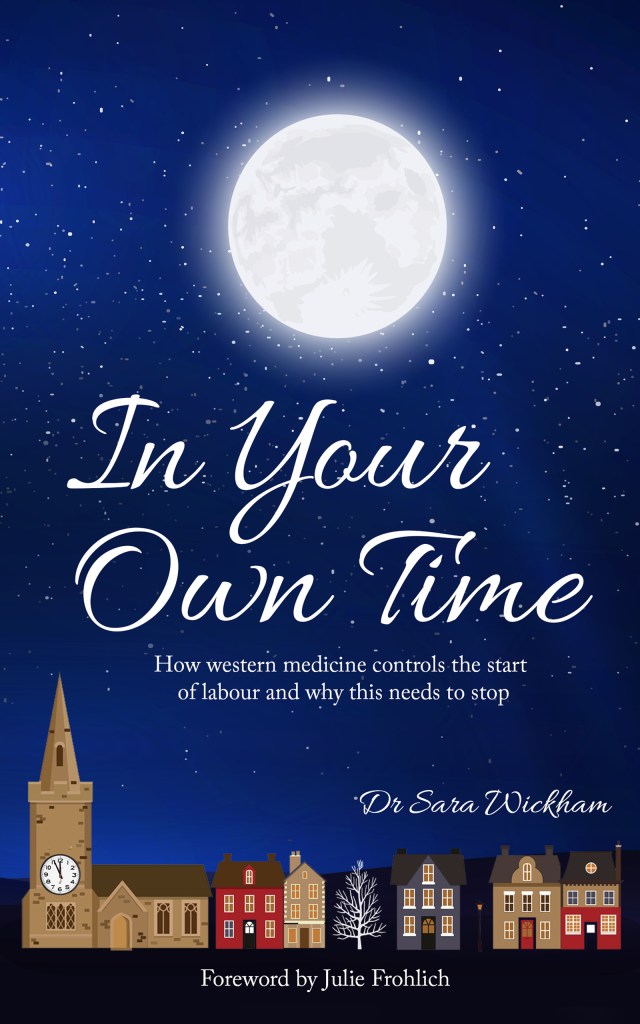
“…in maternity research, we use a lot of outcome measures that are subjective, or dependent on individual opinion. And ‘is a caesarean necessary at this point in time?’ is a good example of this. Professional opinions differ.” (Wickham 2021 – In Your Own Time).

“…we need to be aware that it is humans who make the decision to do a caesarean, or the decision to induce labour in a woman who is in the control group. So this trial isn’t measuring the natural outcome of a labour; it may say more about medical decision making and the level of intervention preferred.” (Wickham 2018).
“…just as Michel Odent once observed that all we could really learn from the Canadian term breech trial was that having “a breech birth in a conventional hospital and in the presence of an obstetrician is dangerous” (Odent 2003: 11), we might consider that the reviews which claimed to show that induction reduces the chance of caesarean teach us that awaiting spontaneous labour while in the care of an obstetrician may increase the risk of being advised to have a caesarean section, which may or may not have been genuinely warranted.” (Wickham 2018).
Women, selection bias, and more critiques
One of the main problems with the ARRIVE Trial is called selection bias. This is where the participants in the trial aren’t representative of women as a whole. There is clear evidence of selection bias in the ARRIVE Trial, and this issue is explained well and in depth in a paper by Carmichael and Snowdon (2019).
Professor Hannah Dahlen also raised some important issues regarding who was and wasn’t in the ARRIVE Trial, and you can read her thoughts here. She has carried out other research whose findings are worth considering as well.
As I also wrote in In Your Own Time:
“Expert maternity researcher Henci Goer describes how a higher proportion of the women developed hypertension or pre-eclampsia over the period of the study than we would expect from looking at the proportion of women who normally develop these conditions. She explained that it’s unclear whether the ARRIVE trial was genuinely studying women with a low risk pregnancy or whether these diagnoses were given to justify induction of labour in some of the women in the control group (Goer 2018). “In short, control-group women weren’t playing on a level playing field, and a case can be made that investigators were interpreting the data to fit their pre-conceived notions.” (Goer 2018).
Henci also has an excellent critique of the trial on her website: Routine 39-Week Induction: Busting the ARRIVE Trial.
Medical critiques
But it’s not just midwives and birth researchers who have critiqued this trial. A number of obstetricians have criticised it too.
J Christopher Glantz wrote about what he called a ‘nondebate’ (because no-one was against early induction) at the 2016 American College of Obstetricians and Gynecologists (ACOG) annual meeting, and published his analysis of the ARRIVE Trial.

“…epidemiologic-based recommendations about routine elective induction of labor at 39 weeks should not be so uncritically accepted. Such recommendations rely on models with little prospective testing that often will not apply to given hospitals, providers, and women. They inflate risks of awaiting spontaneous labor, do not factor in women’s preferences, and would be an enormous increase in medicalization of childbirth. Using the 2015 birth data from the Finger Lakes Region of upstate New York where I practice, routine 39-week elective induction of labor would increase the induction rate from its current 28% to 66%, greatly increasing resource use. Induction of labor often requires more time and resources than spontaneous labor. However, the mathematical models do not take into consideration the strain this would place on obstetrical staff accommodating such high volumes of elective inductions, or how this would affect a labor and delivery ward’s capacity to care for higher-risk women. Such practice recommendations in the absence of adequate prospective testing are entirely inappropriate.” (Glantz 2017).
Inappropriate guilt
Professor Glantz goes on to cover more of the myriad reasons why such a policy is inappropriate.
“Counseling all pregnant women that the safest choice for their baby is to be delivered at 39 weeks does not account for women’s preferences, inappropriately extends conclusions that are tentative at best to many women, and may “guilt” large numbers of susceptible women into agreeing to have unnecessary interventions and procedures.
Who wants to takes risks with one’s baby, even when the actual risks are very small or based on convoluted mathematical models? An individual woman is not a statistical mean, and women should not be coerced into interventions by directive use of modeled statistics.” (Glantz 2017).
This article contains some discussion of mathematical notions that might be a stretch to those who don’t feel comfortable with numbers. But it’s well-written and the arguments are very woman-centred so I think this paper is well worth adding to the files of anyone who talks to pregnant women about such issues.
The patience problem
Another American Professor of Obstetrics and Gynecology offers the following thought:
“The studies in this area are limited by the expectant management group being managed by modern obstetricians, whose inclination for intervention may be higher than is optimal. Larger babies mean longer labors, which may tax the patience of the modern obstetricians, and preeclampsia is alarming to some practitioners who may not be willing to stabilize the patient and wait for the uterus to respond to oxytocin. As gestation advances, there may be less amniotic fluid with consequent benign variable decelerations that are over-interpreted as fetal hypoxemia.” (Scialli 2019).
What an important point. And one which illustrates how vital it is not just to look at the results of research but at the wider context of research and practice. It’s also important to consider the way in which evidence is generated and the belief systems of those who undertake and participate in such research.
Asking the ‘why’ question
Scialli’s suggested solution was a careful review of why the caesareans were done. This is not dissimilar to the work done by Menticoglou and Hall asked back in 2002 when they published Routine induction of labour at 41 weeks gestation: nonsensus consensus.
It is clear that we need randomised controlled trials in order to evaluate the effects of an intervention.
But we also need clear thinking, real world data, and other types of analysis in order to put those results into a wider context and determine whether or not they have relevance for the individual woman in front of us.
And then, it’s up to her to make the decision that is right for her.
ARRIVE is changing practice
Several years after the ARRIVE Trial was published, people are still questioning the results, and sharing concerns about how the data from the trial are being used.
And we know it’s affecting practice within systems of maternity care.
In one example, Freret et al (2025) analysed US national birth certificate data over several years to see how practice changed after the ARRIVE trial was published. They looked at different groups of women giving birth in each time period; before, during, and after the trial’s findings were shared. This kind of approach is called a repeated cross-section study. They take repeated ‘snapshots’ of the population at different points in time.
They then used what’s called an interrupted time series analysis, which looks for a change in trend at a particular moment. In this case, they were interested in when the ARRIVE trial started influencing practice. It helps to show whether an event (like the publication of a major trial) actually changed what was happening.
Their key finding was that the rate of induction of labour at 40 weeks rose from a predicted 18.7% to an observed 20.2% (IRR 1.08, 95% CI 1.05-1.12) once the trial’s findings started being applied more widely. (Freret et al 2025)
Importantly, they found no detectable reduction in the caesarean rate in that population (predicted 25.3% vs observed 25.2%). (Freret et al 2025)
“Dissemination of the ARRIVE trial was associated with an increase in the rate of induction at 40 weeks among patients who remained pregnant after 39 weeks. However, there was no population-level decrease in cesarean delivery, suggesting that the benefits of induction of labor may not extrapolate to this cohort.”
The concerns continue
What is also continuing is the wave of concern about the impact of this trial, from midwives, birth workers, and those obstetricians who think more widely.
We also hear from many women and families concerned that they are being given inaccurate information in an attempt to persuade them to agree to induction of labour.
Rising induction rates are of significant concern to many, and the continued sharing of highly-debated and widely criticised research findings isn’t helping at all.
If you’d like more information, please follow any of the links in this blog post to find out more.
I also have two books written to help women and families understand the issues relating to induction of labour, and to make the decisions that are right for them.

About the Author: Dr Sara Wickham is an author, speaker, and researcher specialising in pregnancy, birth and maternity care. Her work focuses on evidence-based, woman-centred information and informed decision-making, drawing on more than 30 years of midwifery knowledge and experience.
Want to stay up to date and get regular updates on birth-related research and thinking sent free to your inbox?
Plus news of Sara’s books, projects, events, and courses?
Sign up to our email newsletter list here
We’ll send you regular, friendly updates to help you keep up-to-date and stay informed.

Books to help you become informed and make the decisions that are right for you…



If this blog post or any of Sara’s work has helped you or those you care for, please buy her a coffee and help us continue to provide independent birth information online as well as in her books.
Thank you.