
It’s important to understand that labour onset is either spontaneous or induced.
It can’t be both.
It’s also important to understand what those terms mean.
To be clear that, while there are different means and methods of induction, induction of labour by any means or method is still an attempt to bring on birth before the baby is ready to initiate it.
In this blog post, I explain more about what I mean, and why this distinction is important.
Analysis is important
I’ve now been thinking, studying, writing and teaching about the evidence relating to pregnancy and birth for about thirty years.
And, for all of that time, one thing that I have found really useful is to pull apart some of the terms, concepts and assumptions that underpin the ideas we have today.
One of my current concerns, for example, is that women who have membrane sweeping are often not counted in hospital induction statistics. Yet membrane sweeping is an attempt to induce labour, and I think it would be helpful to include those figures. More on this below.
I see terms misused in papers in medical journals and hospital audits, where researchers sometimes classify labour as having a spontaneous onset when induction methods (for instance medicines or devices put on, near or into the cervix to try to make it open) are clearly being used.
I am hearing from a number of colleagues about a growing number of women who are opting for elective, pre-labour caesarean in order to avoid pharmaceutical induction. Yet, as I will also discuss below, this is also a means of induction.
And then we have the induction methods that women and families are trying outside of the medical system. And let me be clear: I absolutely understand why people do this, and offer services in this area. I’m just pointing out that it’s hidden. But, because the idea is often to avoid being pressured into unwanted hospital, pharmaceutical induction, it’s another consequence of the induction crisis that we need to discuss.
The ‘natural induction’ problem
Before I move off that last example, I want to just mention the term ‘natural induction’, which I have been gently challenging for a few years now.
It’s problematic, because the term ‘natural’ isn’t very well defined. Do we mean natural as in spontaneous, or without outside interference, or natural as in holistic remedies?
If we mean spontaneous or without outside interference, then the term ‘natural induction’ is an oxymoron, because the two words in it mean things that are opposite to each other. Even if the speaker doesn’t mean that, I’m concerned that that’s what the listener might hear.
And yes, I realise that the term ‘natural’ is so overused, abused and laden these days to be almost meaningless. But we know what most people mean when they say ‘natural’, and the ‘natural’ course of things when it comes to birth is to let the baby decide when to start labour spontaneously.
Which is the opposite of what we mean by induction.
But I know that some people use the word to describe what they see as ‘natural’ remedies. As I once wrote:
“…most people who use this term [natural induction] actually mean what Hall et al (2012) more appropriately term ‘the use of complementary and alternative therapies for induction of labour’, which I accept is quite a mouthful, especially when the conversation is verbal.” (Wickham 2012).
So I am going to refer to this as induction by holistic therapies, just to make it clear what I mean.
Why do these things matter?
I think all these things matter, especially in our current culture, where we have an induction crisis.
Part of the reason that we have a crisis is that many people in our culture have accepted the belief that women’s and babies’ bodies can’t be trusted to decide when to initiate labour onset. This is coupled with the belief that many people hold, that birth should take place in a hospital with medical assistance.
But these beliefs aren’t supported by the evidence.
A few women and babies will need medical help during pregnancy and birth, but the majority won’t. Many of those who need help nowadays need this as a result of medically-administered pharmaceutical and mechanical induction methods, because of our failure to provide an appropriate environment for labour and birth, or as a result of the side effects of previous medical interventions.
Induction isn’t natural
I want to go back to the article I wrote about the term ‘natural induction’ for a moment.
Because, both then and now, “…part of my concern is that using the term ‘natural induction’ rather than ‘induction using holistic therapies’ might make induction itself sound like it could be a natural, normal thing to do.” (Wickham 2012).
Induction isn’t natural.
And trying to bring on labour – by whatever means – before the baby is ready can mean that we’re bringing babies into the world prematurely.
And, while induction has certainly become more common, we have a growing body of evidence that this is doing more harm than good. This is especially when it is offered to otherwise healthy women, simply because they have one or more ‘risk factors.’
“Let’s remember that the ideal is to save intervention for when it is truly warranted, and let’s also not lose sight of the fact that, no matter what methods are used, attempting to induce labour is – by definition – going to involve trying to make labour happen before it would have happened ‘naturally’.” (Wickham 2012).
This is not a criticism
I’m not for a moment criticising holistic therapies, therapists or those who choose them. Anecdotally, these therapies seem to have far fewer unwanted effects than the pharmaceutical and mechanical means of induction used in western medicine. We have very little evidence about this, though, and almost none about whether or not such therapies are effective as a means of inducing labour. That’s partly because the people who control research funding aren’t generally the same people who value acupuncture and herbal medicine.
I also understand that many of the women who attempt to induce labour with holistic therapies are trying to avoid medical intervention, which tends to culminate in having a pharmaceutical or mechanical induction in hospital. No judgement here. I’m simply pointing out that, if aim is to bring labour on sooner than the baby would have initiated labour onset themselves, it’s a form of induction, as opposed to awaiting spontaneous labour.
And it should therefore be a part of the conversation.
Membrane sweeping
Membrane sweeping, or a stretch and sweep. is also often presented as an alternative to induction, when it isn’t.
This is another way of trying to bring on labour sooner than it would have started on its own.
Membrane sweeping is a mechanical method of induction, which I know sounds weird, but that’s the term used for methods which stretch the cervix in an attempt to induce labour. Using a balloon catheter is also a mechanical method of induction.
Over the past few years, membrane sweeping has crept into routine use in antenatal clinics and pathways. In some areas, all women are offered this at a certain stage in pregnancy. Sometimes, it happens without consent, which is appalling.
It’s another method of induction, although it’s not particularly effective.
However, as I mentioned above, it is generally not counted as induction in research studies, or hospital statistics. Which is frustrating, because this also hides the true number of women/babies who undergo attempts to bring on their labour sooner than if labour had begun in their own time.
At the other end of the spectrum
Both induction by holistic therapy and induction by membrane sweeping are sometimes done in an attempt to avoid pharmaceutical induction.
At the other end of the spectrum, but with the same intention of avoiding pharmaceutical induction in hospital, some people also see elective, pre-labour caesarean as an alternative to induction.
But again, this is also another form of induction.
As a reminder, induction is when we try and make birth happen sooner than would have happened naturally.
That’s exactly what elective, pre-labour caesarean does.
Still no judgement. But it’s important to understand that elective, pre-labour caesareans have many risks and consequences. A key one is the chance that, because it’s also a means of inducing labour, the baby may be born too early.
You’ll find more on this, and many other topics, in my new book, Midwifery Wisdom.
In it, I explore the knowledge that experienced midwives develop over years of supporting women through pregnancy, birth, and the postnatal period. How midwives use their senses to assess labour progress, why the maths behind obstetric boundaries needs rethinking, the value of postnatal tea and toast, and when to put your gloves on. I cover topics from risk to cats in a book written to help people understand midwifery, and midwives better understand the value of their own skills and wisdom.

Outpatient induction
I also want to briefly mention outpatient induction, which is a relatively new thing.
Outpatient induction occurs where a woman is given the first stage of a medically managed pharmaceutical or mechanical induction and then, as long as all is well, spends the first part of her labour at home or in a birth centre before (usually) returning to hospital to have her baby.
The means in this case is usually a balloon catheter and/or a pharmaceutical drug. (There’s lots more information on the different methods, how they work, and what the side effects are in my book, Inducing Labour: making informed decisions).
Outpatient induction was brought in to reduce strain on maternity units, and because so many women are dissatisfied after having induction in hospital.
And everything I’ve written above relates to outpatient induction as well.
Two elements to induction
I have spelled out some of the different types of induction because it is then easier to show how there are two elements to induction.
(1) The fact that we’re trying to bring labour on earlier than the baby might have chosen.
Because yes, although we have more to learn about this, we’re confident that it’s babies who decide when labour starts. All of the methods above are trying to bring on labour sooner than the baby would have initiated it.
(2) The means and methods by which we do that.
As I noted above, some people find holistic therapies, membrane sweeping, and/or outpatient induction methods more palatable than the pharmaceutical and mechanical methods used in hospital inpatient induction.
Others find elective, pre-labour caesarean more palatable than the pharmaceutical and mechanical methods used in hospital inpatient induction.
I totally understand why.
It’s really interesting that first and last these approaches are so wildly different, but I get it.
But every single one of these approaches exists in relationship to the way that the medical model has very effectively convinced many people that women’s bodies/babies can’t pick the correct time to go into labour spontaneously.
Am I criticising these approaches?
I want to keep making it clear that I’m not criticising any of these approaches, or those who opt for them.
I appreciate that having cervical ripening agents is really different from having intravenous oxytocin.
Yes, outpatient membrane sweeping is different from hospital induction, and visiting an acupuncturist or other therapist is very different from being alone on the antenatal ward for three or four days. Especially if you’re experiencing the pain that comes from having Prostin.
And if any of those are what someone wants, then I’m absolutely not trying to get in their way.
I have many colleagues who undertake holistic therapies, and I value their work.
I just want us to be clear that all of these approaches are forms of induction.
Which means that they all carry some of the implications and potential downsides of induction of labour, irrespective of the specific methods and means that are used.
Weighing up the pros and cons
Some people argue that holistic methods and membrane sweeping are less likely to lead to the sorts of problems that the drugs and interventions that are used in hospitals can lead to. On the whole, I would agree, although they do have downsides and we don’t have good evidence on this, as I explained above.
But here’s the key thing. Anything that can induce labour can cause the baby to be born before it is ready.
It’s also important to remember that nature is by no means benign. Tsunamis and volcanoes are just as natural as daisies and honey bees. Many pharmaceutical drugs are based on naturally occurring substances, and some herbal and plant-based medicines can have some very powerful effects. As can membrane sweeping.
And using any of these induction methods means that, if things don’t go exactly to plan, you can find yourself very quickly having a lot of other interventions which you may have hoped to avoid.
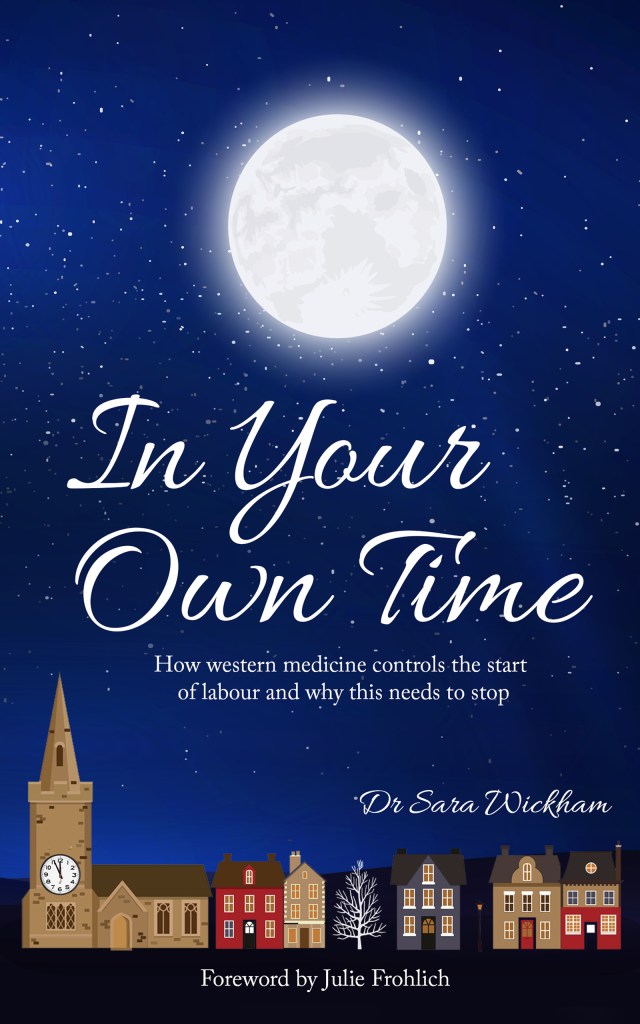
Trying to induce labour by any means before the baby initiates labour itself has downsides, as I described in In Your Own Time. We can end up with babies who are born too early, and with mums and babies who have intervention and unwanted side effects – some of which are long term – brought about by the induction interventions.
Undermining self-worth, and other unwanted consequences
The seemingly simple act of convincing a woman that her and her baby’s body is not capable of going into labour at the right time on its own can also undermine her self worth and ability to feel confident in her body.
Which, as Caroline Flint once pointed out, is really problematic. We need people to be at their strongest and most confident as they become new parents and take on the responsibility for a tiny baby.
Induction of labour can be lifesaving in a few situations, such as where a woman has serious pre-eclampsia. It’s important to remember that.
But induction also has unwanted medium- and long-term consequences for women, babies and families. It can lead to birth trauma and mental health problems for women, although we don’t have nearly enough evidence on this.
Neither do we have enough evidence on which of these unwanted consequences stem from the methods themselves, which stem from other factors (such as the setting of the induction), and which are a consequence of having convinced two or three generations of women and families that it’s a good idea to try to bring on labour sooner than the baby and mother were truly ready for it.
And by truly ready, I mean ready in the older, primal part of their brain and in their bodies. I understand that many women feel tired, hot, uncomfortable, and fed up towards the end of pregnancy, and want to be done with it and meet their baby. But that’s sometimes just one part of our brain – the very modern neocortex – wanting to make things happen before the rest of us is truly ready.
It’s your decision, but please find out for yourself
In case I haven’t said it enough yet, I am making no judgement about your decision. It’s none of my business, anyway. You do you.
I simply want to help people unpack and understand the issues and the evidence.
That’s partly because I see some of the unwanted end result of the increased induction rates.
If you want to know what I mean by that, come and find me on Instagram, look for any post in which I discuss induction of labour, and then read the comments. You’ll see for yourself just how many women regret deciding to have their labour induced. You’ll also see some who were happy with their induction too, which is brilliant for balance, but they are generally in the minority.
Induction of labour is increasingly being offered to healthy women for questionable reasons or because they have a ‘risk factor’ rather than an actual medical problem.
As a result of this, more women and families are turning to holistic induction methods, or medical outpatient interventions such as membrane sweeping. This isn’t because they want induction, but because they want to avoid inpatient induction with pharmaceutical methods.
Induction of labour isn’t a bad thing per se.
I do think it’s being overused, though.
And I think that calling it what it is may help better illuminate the situation we’re in.
That way, women and families can make decisions based on an accurate understanding of their options, the evidence, and the wider issues.
For more information
If you’d like to explore the evidence, learn about induction and better understand the issues, I have written two books about induction of labour:
Hall HG, McKenna LG, Griffiths DL (2012). Complementary and alternative medicine for induction of labour. Women and Birth 25(3): 142-8.
Wickham (2012). When is induction not induction? EM 3(10): 50-51.

About the Author: Dr Sara Wickham is an author, speaker, and researcher specialising in pregnancy, birth and maternity care. Her work focuses on evidence-based, woman-centred information and informed decision-making, drawing on more than 30 years of midwifery knowledge and experience.
Want to stay up to date and get regular updates on birth-related research and thinking sent free to your inbox?
Plus news of Sara’s books, projects, events, and courses?
Sign up to our email newsletter list here
We’ll send you regular, friendly updates to help you keep up-to-date and stay informed.

Books to help you become informed and make the decisions that are right for you…



If this blog post or any of Sara’s work has helped you or those you care for, please buy her a coffee and help us continue to provide independent birth information online as well as in her books.
Thank you.
1 comment for “Let’s be clear: labour onset is either spontaneous OR induced!”