

An induction crisis is occurring in the UK, and many other countries.
Increasing numbers of women are being told that their labour needs to be induced.
In most cases, this isn’t because they have an actual medical problem (such as serious pre-eclampsia), but because they have a risk factor, such as being older, having a higher BMI, having a suspected large baby, having conceived by IVF, or being pregnant for more than a few days after their ‘estimated due date’.
Women often report that, if they express concern or try to decline induction, they encounter coercion, with staff telling them that their baby is at high risk.
We’re not getting the full picture
In many situations, what women and families are told about risk is either not true, or not the full picture.
It is true that there is sometimes a marginal increase in the chance of adverse outcomes for certain groups of women, but this is generally very small.
Induction carries risks too. So the pros and cons needs to be weighed up.
And there are also significant advantages to awaiting spontaneous labour, as well as medium- and long-term risks of induction which often aren’t mentioned. There’s lots more on that in my book, In Your Own Time.
When those who have agreed to induction arrive at the hospital, however, they are often told that there is no bed for them, or that their induction will be delayed because of staffing shortages.
Sometimes, they get a phone call the night before they would have gone to hospital, telling them they need to wait another two or three days.
So naturally, they’re worried.
Risk, stress and why we’re all fed up
It’s no surprise that over-emphasis of risk leads to women worrying that their baby’s life is in imminent danger from waiting (even though that’s not the case), and then feeling stressed when they’re told that they have to wait longer.
Sometimes at home. Sometimes on a ward where their partners and loved ones can only visit at restricted times.
The increased stress isn’t good for labour hormones, and means they’re probably less likely to go into labour spontaneously. It’s no wonder that induction leads to adverse outcomes.
Another related problem is that sometimes the women whose babies are genuinely having problems aren’t able to have their labour induced in a timely manner. That’s because all the beds are full of healthy women having healthy babies who are being induced simply becasue they have ‘risk factors’ (rather than actual medical problems).
If we focused our efforts on saving intervention for those who truly need it, and creating optimal conditions for birth for those who don’t, we would likely have much better outcomes overall.
Especially if we stop focusing just on the short-term physical outcomes and look at mental health, medium- and long-term physical health, and birth trauma.
Variation and delays
This situation has been discussed in a number of research studies over the past few years.
The most recent is a 2024 report of a cross-sectional survey of maternity units in the UK.
Researchers gathered details from specialist obstetricians working at 54 maternity units, which is 35% of the units in the UK.
The responses showed that there is, “…substantial variation in induction rates, processes and policies across UK maternity services.” (Taylor et al 2024).

The induction rates varied from 19.2% to 53.4%.
And this doesn’t include those who have pre-admission induction interventions, such as a stretch and sweep, or those who have elective, pre-labour caesareans, which also mean that labour starts before the baby initiates it.
Of the units surveyed, 72% (39/54) had agreed induction criteria, but, “…these varied widely and were not all in national guidance.” (Taylor et al 2024).
And the research again confirms that, “Delays appear to be common and are a cause of safety concerns.” (Taylor et al 2024).
The delay problem
Taylor et al‘s (2024) findings about delays confirm the concerns of many midwives.
In the abstract of their paper, they state that one in five units (19%, 10/54) reported delays in hospital admission for induction ‘often’ or ‘always’, with another third of all units (19/54) reporting delays ‘sometimes’.
When we look more closely at the data, however, a quarter of the units either answered ‘not applicable’ to this question, or did not give an answer. So the actual frequency of delays might be higher; we can’t tell from the data given by the respondants.
Another important source of delay is in moving women from the antenatal ward to the delivery suite/labour ward once the induction is progressing, or in order to progress it (for instance by artificially rupturing their membranes). This is a key issue when it comes to satisfaction (or dissatisfaction) with induction, because women are generally not able to have a partner or companion with them around the clock until they have moved to a labour ward.
“Delays in women being transferred to DS once IOL was in progress (either for ARM or if membranes ruptured) were reported more frequently than delays in admission due to bed availability, with over half (n = 30, 56%) of units reporting this occurring ‘often’ and 4 (7%) ‘always’. 17 (31.5%) units had an agreed guideline definition of delay when women were clinically ready for transfer to DS. Of the 15 units who reported a specific defined time, there was a wide range (>2 hours to 5 days) with a mean of 14 hours 40 minutes. There was no association between delay in moving to Delivery Suite and the size of unit (Fisher’s exact test, p = 0.303) or induction rate (ANOVA, p = 0.1249).” (Taylor et al 2024).
Other findings in this area include that:
“Delays triggered incident reports in 36/54 (67%) and resulted in harm in 3/54 (6%).”
“Induction was an area of concern (44%, 24/54); 61% (33/54) reported induction-focused quality improvement work.” (Taylor et al 2024).
We need change
The authors of the article conclude that, “With induction rates likely to increase, improved guidance and pathways are critically needed to improve safety and experience of care.” (Taylor et al 2024).
I don’t disagree with the part about the need for improved guidance and care.
But I’m not personally convinced that increased rates of induction are inevitable.
And there’s plenty of evidence to suggest that increased rates of induction may do more harm than good, as I’ve written about extensively on this website and in my books.
The misinformation problem
We know, as above, that the idea of a baby being ‘at risk’ is often used to persuade women to agree to induction.
This doesn’t just come from the maternity services. Misinformation and using the notion of risk as a scare tactic is a common theme in certain areas of the media and social media.
From misquoted statistics, to personal horror stories, to scary ‘spin’, we seem to be swamped with unhelpful information.
We are receiving more and more comments than ever before from people who are concerned about this, or have experienced it.
So I have updated this blog post in the hope of showing you that there IS balanced information out there, that can help you to navigate your decisions.
And it IS your decision. More on that here.
Can I help you?

Over the past couple of years, I have responded to the increase in induction misinformation by increasing the number of resources that we have available on this topic.
First, I regularly blog about induction-related issues on my website, and we have an Induction information hub which gives you handy links to all of my induction-related blog posts. That’s a great link to share with friends, colleagues or clients.
I get that you don’t want to have to keep checking back here to see what’s new, and you don’t have to! We keep our friends informed by email about the latest research and blog posts in our Birth Information Update – click here if you don’t get that and would like to.
We also share lots of induction information on Instagram and Facebook. If you don’t already follow me on there, come on over and join me. I’m @drsarawickham and you’re welcome to share and repost my pics to help spread the word. (Always make sure you leave the original author picture, text and credit intact. That way, others can find a creator’s website and resources too, and creators can make a living and keep going). My Facebook page is here.
I regularly blog about the issues, so bookmark my website.
More induction resources
I also have two books available on induction.
There’s Inducing Labour: making informed decisions
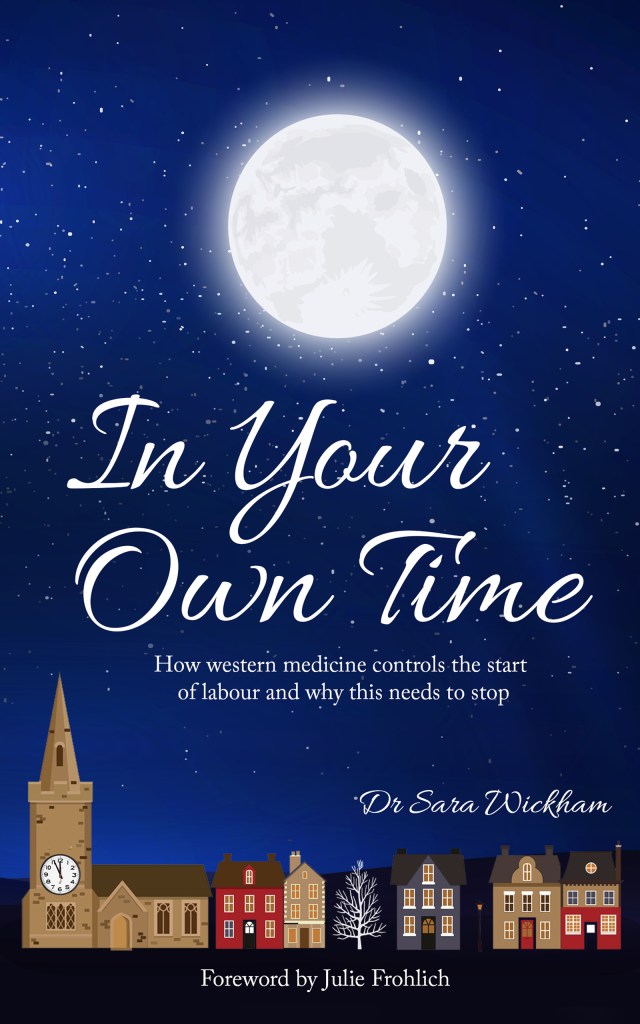
and In Your Own Time: how western medicine controls the start of labour and why this needs to stop.
Find out the differences between them here.
I have another book on making decisions in pregnancy and birth.
All of these are aimed at helping women and families to better understand the issues and the evidence and to be able to make the decisions that are right for them.
I hope that some of these resources help you (or those you care about or serve) to understand the issues and make the decisions that are right for you.
Taylor B, Cross-Sudworth F, Rimmer M et al (2024). Induction of labour care in the UK: A cross-sectional survey of maternity units. PLoS ONE 19(2): e0297857.

About the Author: Dr Sara Wickham is an author, speaker, and researcher specialising in pregnancy, birth and maternity care. Her work focuses on evidence-based, woman-centred information and informed decision-making, drawing on more than 30 years of midwifery knowledge and experience.
Want to stay up to date and get regular updates on birth-related research and thinking sent free to your inbox?
Plus news of Sara’s books, projects, events, and courses?
Sign up to our email newsletter list here
We’ll send you regular, friendly updates to help you keep up-to-date and stay informed.

Books to help you become informed and make the decisions that are right for you…



If this blog post or any of Sara’s work has helped you or those you care for, please buy her a coffee and help us continue to provide independent birth information online as well as in her books.
Thank you.