
The myth of the ageing placenta is one of obstetrics’ favourite fairy stories.
Quite a few women report that their doctor has told them that all placentas become aged and insufficient as pregnancy progresses.
That statement is often closely followed by a recommendation for induction, presumably so that obstetrics can save our babies from our faulty bodies.
But this myth isn’t evidence-based, and there are good, scientific reasons to challenge this unhelpfully scary story.
A common fairy story
I’m not surprised that this such a common fairy story. We receive more comments, emails, and enquiries on induction of labour than everything else put together, and I’m still shocked at some of the things that women get told in order to try to persuade them to agree to induction.
I know that one reason I see so much on this topic is because I have written about it myself. But I’ve written about plenty of other topics too and induction of labour is still consistently the most discussed.
When we analysed the nature and content of the comments that we received while tidying our email folders recently, we saw that many women were being told they ‘needed’ induction or that their baby was ‘at risk’ without being given good evidence to support this claim.
One hot topic
One issue that we heard about more than ever before was from women who had been told that their baby was at risk because their placenta was ‘insufficient’ or ‘ageing’.
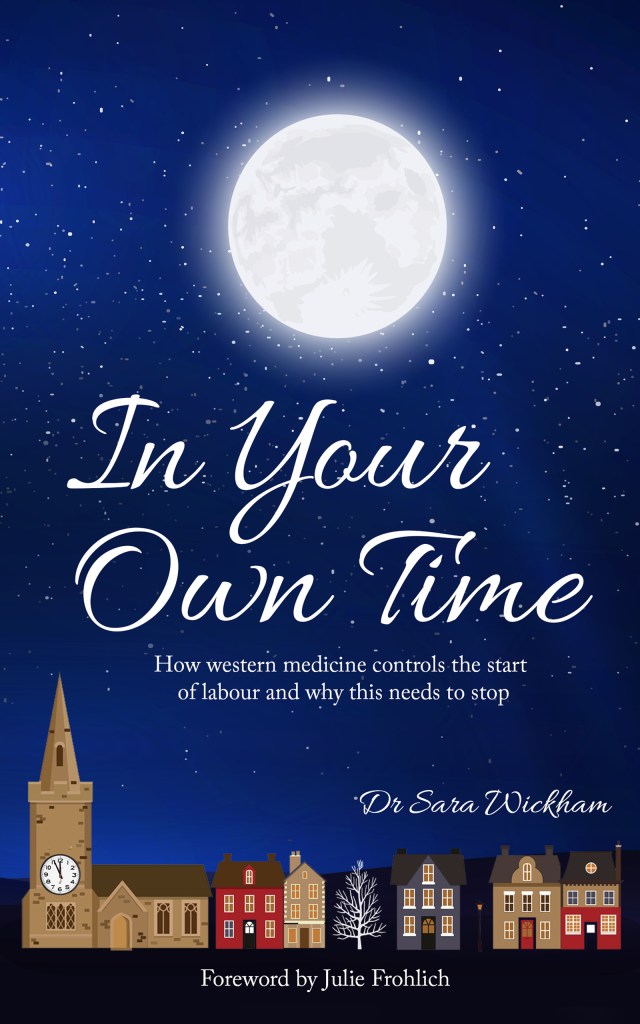
I’m not a stranger to this topic. In In Your Own Time, I wrote that:
“The concern here is that the concept of placental insufficiency could be described as rather ‘slippery’, and there is no evidence to suggest that there is a correlation between placental insufficiency and length of pregnancy.
As an obstetrician friend of mine likes to say, if a woman’s placenta isn’t working well at 23 weeks, then it is unlikely to be working well by 39 weeks. But if it is working well at 40 or 41 weeks then there’s no good reason to think its function is suddenly going to decline over the next few days.” (Wickham 2018)
Some placentas do have problems
As this quote acknowledges, some women have problems with their placentas, and need some help in order for their babies to be born healthy. This may sometimes include early induction.
This applies to a relatively small number of babies, however. In this situation, problems are usually discovered before term, for instance because a baby isn’t growing well. The women we were hearing from were being told that their placenta was ‘getting knackered’ at 38 or 39 weeks, with no evidence or recent test results given to back this story up.
It’s also true that there is some evidence that placental dysfunction may play a part in some stillbirths. There might be more that we could do or offer in order to prevent this, or there might not. But this also doesn’t justify the blanket statement that every woman’s placenta ages in a problematic way.
A useful resource
I was delighted when scientist, doula, and birth educator Dr Sophie Messager published a blog post on this topic: The Myth of the Aging Placenta.
Sophie has a PhD in physiology of reproduction and twenty years of research experience, which means she is far more qualified to discuss topics like this than the vast majority of obstetricians.
The article is long and detailed so, as she recommends herself, you may want to make a cup of tea before settling down with it.
An important debate
There are a few things that I particularly appreciate about Dr Messager’s article.
First, she offers an important discussion about the way in which theories such as this one are sometimes presented as accepted fact by certain groups when there is still a lot of debate, uncertainty and disagreement. Her background in science makes her well qualified to make the point that even (or perhaps especially) at the highest levels of scientific advance and debate, experts often disagree with each other.
I can attest to this from my own experience too. I count myself lucky to have many other academics and scientists in my social circle and I have sat through and participated in heated (although generally also professional, respectful, friendly, and sometimes humorous) debates on topics from archaeology to transport geography (a topic often discussed at our house, so be warned if you come for dinner). I spotted early on in my life that, in general, the cleverer the person, the more they are apt to listen to others and the less likely they are to be dogmatic about what is ‘right’ or ‘wrong’.
There’s lots more on this in my book, Midwifery Wisdom.
That’s because of another really important point: there isn’t always a right or wrong, and our knowledge is growing and changing all the time. Many of the things I learned as a student midwife some twenty-five years ago have now changed. The illustrations of breast anatomy that were available when I learned about the anatomy of breastfeeding, for instance, are no longer considered accurate, and that’s just one example.
But is the revised picture that we have today going to still be considered ‘true’ and/or relevant in another twenty-five years’ time?
Who knows…
Knowledge isn’t fixed or certain and claims that it is should be treated with caution; they often say a lot about the mindset of the person making the claim.
Different interpretations
But the part of Dr Messager’s blog post that I found the most enlightening was when she looked, with the benefit of her own scientific background in the physiology of reproduction, at each of the changes that are being cited as evidence of placental ageing.
She showed how they can also be interpreted as simply being signs of the changes that are associated with growth and development, which is exactly what our placentas and babies are supposed to be doing.
This is an important element of the debate that needs more discussion.
As I noted in Inducing Labour: making informed decisions, “our modern culture is not very tolerant of the concept of ageing generally, especially in women, so it is not that surprising that we so easily accept the idea that the aging placenta is unwanted and problematic.” (Wickham 2018)
Myths, Fairy Stories, and Theories
Throughout my career, I have seen many examples of theories that have been proposed, often by someone keen to make their name (and perhaps also give it to a part of a woman’s anatomy, a procedure or a saleable tool), and which have later been shown to be false and potentially detrimental.
And yes, I’ve also seen theories become more trusted and valuable with time as well.
Perhaps the key lies in being able to differentiate between knowledge, evidence and wisdom.
To quote Dr Messager once more, “The concept of the aging placenta is still just that, a theory. Unfortunately the majority of the publications cited in this post fail to acknowledge this, and take this theory as proven.”
I recommend reading this blog post in full if you’d like to delve into this area more deeply.
You’ll find more on this, and many other topics, in my new book, Midwifery Wisdom.
In it, I explore the knowledge that experienced midwives develop over years of supporting women through pregnancy, birth, and the postnatal period. How midwives use their senses to assess labour progress, why the maths behind obstetric boundaries needs rethinking, the value of postnatal tea and toast, and when to put your gloves on. I cover topics from risk to cats in a book written to help people understand midwifery, and midwives better understand the value of their own skills and wisdom.


About the Author: Dr Sara Wickham is an author, speaker, and researcher specialising in pregnancy, birth and maternity care. Her work focuses on evidence-based, woman-centred information and informed decision-making, drawing on more than 30 years of midwifery knowledge and experience.
Want to stay up to date and get regular updates on birth-related research and thinking sent free to your inbox?
Plus news of Sara’s books, projects, events, and courses?
Sign up to our email newsletter list here
We’ll send you regular, friendly updates to help you keep up-to-date and stay informed.

Books to help you become informed and make the decisions that are right for you…



If this blog post or any of Sara’s work has helped you or those you care for, please buy her a coffee and help us continue to provide independent birth information online as well as in her books.
Thank you.