
There has been a steady shift in maternity research and practice towards recommending earlier and more frequent intervention in pregnancy and birth.
Induction of labour is one of the clearest examples of this trend, but it is not the only one.
In this blog post, i want to discuss the apparent disappearance of an ethical principle that once played an important role in healthcare decision-making: the precautionary principle.
What is the precautionary principle?
At its simplest, the precautionary principle suggests that when we are unsure whether an action, policy, or intervention is safe or beneficial, the burden of proof should lie with those proposing the intervention, not with those wishing to avoid it.
In other words, intervention should have to demonstrate that it is not harmful, rather than physiology being required to prove itself superior.
This principle has long been used in public health and environmental ethics. It has particular relevance in maternity care, where we are dealing with healthy women and babies, complex physiology, and interventions that can have wide-ranging and long-lasting consequences.
A change in focus
But over the years, there has been a change in focus. We have moved away from the understanding that physiological birth is the norm, and should be supported unless there is genuine reason for intervention.
This can be seen in the literature on induction of labour. I have, looked at several studies which claim benefits to induction that aren’t supported by the findings of the same study. Others claim that, contrary to people’s lived experience and a significant volume of research, induction of labour actually reduces the chance of caesarean section. And nowadays, most women are told that they will need induction, sometimes within weeks of becoming pregnant.
Through this and many other actions, proponents of an intervention-heavy approach repeatedly express doubt about a process which has worked for millennia, while simultaneously defining pregnancy and birth in relation to their management decisions rather than women’s agency and the abilities of their bodies.
A growing doubt about normal processes
Much of the contemporary maternity literature frames pregnancy and birth in terms of risk management.
Papers increasingly focus on identifying the “risk of waiting”, the “hazards” of expectant management, and/or the supposed benefits of intervening earlier. The downsides of intervention often go unmentioned, as do the benefits of waiting, or letting nature take its course.
Even the language used in research titles and abstracts often signals a particular stance before the reader has had a chance to appraise the methods or findings. This matters, because language shapes thinking, and thinking shapes attitudes, beliefs, and practice.
When pregnancy is defined primarily by the possibility of adverse outcomes, and when intervention is presented as the default pathway, it becomes difficult to maintain a genuinely precautionary approach. And instead of asking whether an intervention is necessary or proportionate, people begin to ask why it has not yet been used.
Objectifying women, narrowing the lens
Another feature of this shift is the way women are often positioned and discussed within research and policy.
Terms such as “low-risk gravid” or similar abstractions contribute to a view of women as objects of management rather than active participants in decision-making.
This linguistic distancing makes it easier to justify population-level recommendations that overlook individual context, values, and preferences.
It also makes it harder to acknowledge that many interventions, while increasingly common, are not benign. And that their wider effects on experience, autonomy, and wellbeing matter.
Where is the precautionary principle now?
The irony is that maternity care should be one of the areas where the precautionary principle is most rigorously applied. Birth is not a disease process, and most women will labour and give birth safely without intervention. They have an even greater chance of this if they receive continuity of midwifery care.
Yet in practice, the principle often appears to have been inverted.
Women are increasingly asked to justify declining intervention, rather than clinicians being required to demonstrate that an intervention offers clear benefit that outweighs its potential harms.
In some really worrying cases, clinicians are calling for all women to sign a consent form to give birth as nature intended. This is very worrying, for the reasons explained above.
But it’s also a ridiculous idea. Physiological birth is, in the vast majority of cases, the natural outcome no matter whether anyone does anything or just leaves the woman alone. (I’m not advocating doing that, by the way. It’s a thought experiment to make my point.)
Do professionals need to clearly document that they offered advice and/or recommendations, in order to ensure they cannot later be accused of negligence?
Yes.
But it’s a far cry from documenting that advice was offered to asking all women to sign a piece of paper intended to throw doubt on their body’s ability to successfully give birth.
The risk problem continues
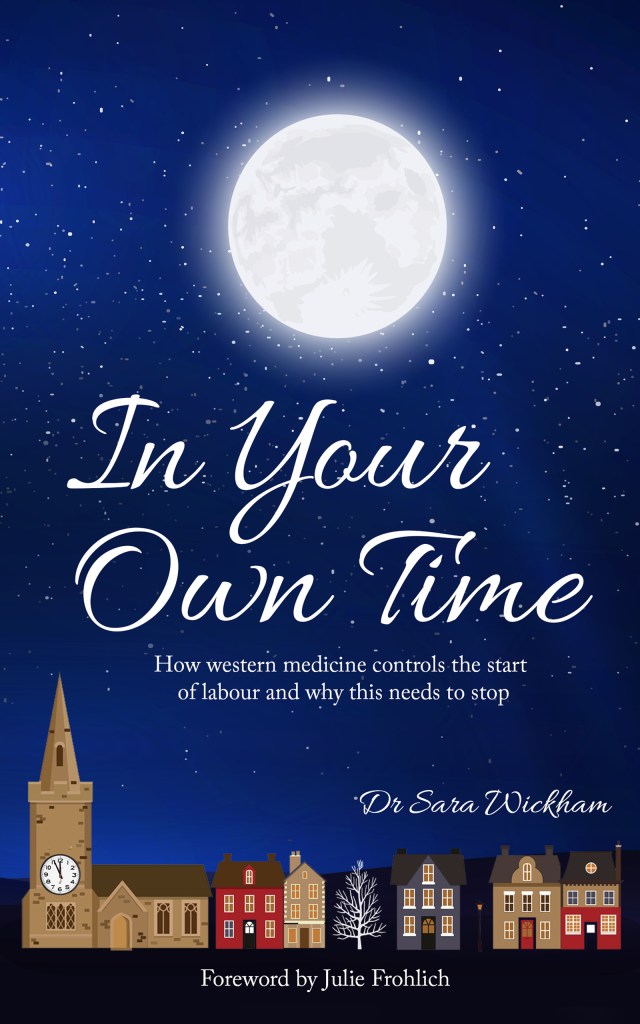
The problem of over-intervention is particularly evident when recommendations are based on small absolute risk differences, uncertain evidence, or outcomes that matter more to institutions than to women themselves. (See In Your Own Time for more on all of these things).
Once such recommendations are embedded into guidelines or local policy, they can quickly become rules, even when the evidence underpinning them is limited or contested.
I know that many readers of my work are practising in areas and systems which may be affected by these issues. If nothing else, I’d like to help others find ways of speaking about the issues, and I think that referencing the precautionary principle can be a good way to do that.
Why this still matters
The precautionary principle reminds us to ask:
- Why is this intervention being offered?
- What are the downsides, alternatives (including doing nothing), and potential harms?
- Who or what has the burden of proof? The woman’s body, or the intervention?
These are ethical questions, not just clinical ones. And they can be useful in a culture where women’s bodies, midwives’ skills, and the ideal of physiological birth are being questioned and often denigrated.
If maternity care is to remain truly evidence-based, woman-centred, and respectful of physiology, then we need to reclaim ethical frameworks that help us highlight the real issues, and point out how far we have moved from medicine’s own ethical ideal.
To me, the precautionary principle is a great starting point.
The sentence, “what happened to the precautionary principle?” is one of my favourite ways of pointing out that, ethically, medical intervention has to prove itself against nature.
Not the other way around.
You’ll find more on this, and many other topics, in my new book, Midwifery Wisdom.
In it, I explore the knowledge that experienced midwives develop over years of supporting women through pregnancy, birth, and the postnatal period. How midwives use their senses to assess labour progress, why the maths behind obstetric boundaries needs rethinking, the value of postnatal tea and toast, and when to put your gloves on. I cover topics from risk to cats in a book written to help people understand midwifery, and midwives better understand the value of their own skills and wisdom.

For more information on induction:
And if you’d like more information on navigating maternity care and making the decisions that are right for you:

About the Author: Dr Sara Wickham is an author, speaker, and researcher specialising in pregnancy, birth and maternity care. Her work focuses on evidence-based, woman-centred information and informed decision-making, drawing on more than 30 years of midwifery knowledge and experience.
Want to stay up to date and get regular updates on birth-related research and thinking sent free to your inbox?
Plus news of Sara’s books, projects, events, and courses?
Sign up to our email newsletter list here
We’ll send you regular, friendly updates to help you keep up-to-date and stay informed.

Books to help you become informed and make the decisions that are right for you…



If this blog post or any of Sara’s work has helped you or those you care for, please buy her a coffee and help us continue to provide independent birth information online as well as in her books.
Thank you.