

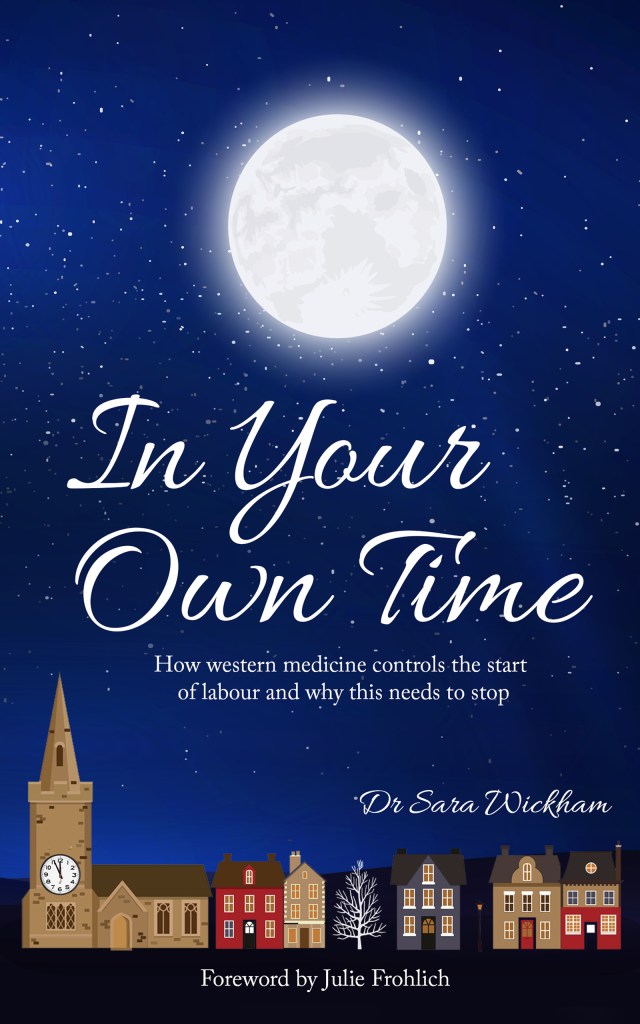
Over the years, I have shared a number of studies showing that induction increases the chance of caesarean. This is also something that I explain in depth in my book, In Your Own Time.
It’s important that we discuss this topic openly and honestly, so that people can understand the evidence in this area.
That’s because many women and families are told that induction actually decreases their chance of having a caesarean.
But that’s not actually true in the real world.
In the real world, having your labour induced increases your chance of having a caesarean.
I will explain why in this blog post.
(Be aware that this is a long post. You may need to make a cup of tea first!)
Why did an obstetrician tell me that induction leads to fewer caesareans?
The people who claim that induction leads to fewer caesareans are quoting the results of one study, which was very flawed.
The study is called the ARRIVE Trial.
Many experts have criticised the ARRIVE Trial. Including Henci Goer, who has written this brilliant blog post: Routine 39 Week Induction: Busting the ARRIVE Trial.
Yet the ARRIVE Trial is still frequently quoted by people who prefer to induce labour.
In a nutshell, the women in the ARRIVE Trial who had their labours induced at 39 weeks were less likely to have a caesarean than the women in the ARRIVE Trial who weren’t in the ’39 week induction’ group.
But these results came about because of the way that the trial was set up and run. They don’t reflect what happens to women in real-world maternity care settings.
So it’s important to look at what happens in the real world, and not the more rarefied setting of a research trial, where things are controlled and often happen in a different way to how they would for women in ‘normal’ maternity care settings.
Why real world data are important
In this post, I’m going to explain the ‘real world’ issue in more depth, and discuss a few of the studies which show the caesarean rates after induction in real-world settings. I could cite many more which show the same results. Those on this page ones that I wrote about in my books, courses and emails as they were published.
I also want to add that there is good reason to try to reduce the number of caesareans.
Caesareans are associated with poorer outcomes for both women and babies (Hu et al 2024).
And another recent study has shown that having a caesarean is associated with an increased risk of subsequent stillbirth, with a greater risk of this among women who have an elective/pre-labour caesareans (Al Khalaf et al 2024).
Hu et al (2024)
One recent study on this topic is by Hu et al (2024). Researchers analysed population-based historical cohort data on 239 094 women who gave birth in one Australian state (Queensland), over a six-year period.
The researchers were careful to focus their analysis on healthy women who did not have complicated pregnancies (such as preterm labour, multiple births, or breech presenting babies). They also separated out data on women having their first baby, as outcomes can be different for those having their first baby and those who have had one or more babies before.
Of the 239 094 women whose data were included in the analysis, 36.7% of them gave birth following induction of labour.
The researchers found that the likelihood of primary caesarean following induction of labour was significantly higher in all women who laboured at 38 and 39 weeks, and in women having their first baby who laboured at 40 weeks.
Women whose labours were induced at 37 weeks and women having a second or subsequent baby at 40 weeks also had a higher likelihood of having a caesarean than women who awaited spontaneous labour, but the difference wasn’t statistically significant in these groups. (There may be a number of reasons for this, and there’s more on the differences by week in a study that I discuss below).
More acknowledgement of the ARRIVE Trial problem
I want to share one specific paragraph from Hu et al‘s (2024) study, as it illustrates how the researchers themselves are well aware of the flaws of the ARRIVE Trial. I have added bold to show where they are referring to how the ARRIVE Trial, and how it doesn’t reflect what happens in the real world.
“Although our results did not align with those meta-analysis results based on clinical trials and some studies conducted in the USA, the differences are probably attributed to different methodological approaches and differences in the women included and the setting where they gave birth. Our focus is on the association between IOL and CS outside a clinical research setting, including all women regardless of parity and risk status, giving birth at any birth place (home, birth center, and hospital) in Queensland with presumed provider-level differences regarding the decisions of whether, why, and when to perform IOL.” (Hu et al 2024).
Butler et al (2024)
Earlier in 2024, an Australian study showed (again) that induction for non-medical reasons in healthy women increases the chance of caesarean section.
By non-medical reasons, we mean where induction is offered because of a risk factor rather than because of an actual medical condition, such as pre-eclampsia.
Analysis of data from all of the births that occurred in Victoria, Australia over an eight-year period showed that induction rates increased over that time.
The researchers also discovered that induction in lower-risk women having their first baby was associated with a higher chance of having a caesarean.

As with other studies on this topic, induction didn’t make a significant difference to perinatal mortality, which was rare in both induced and non-induced women.
Offerhaus et al (2023)
Let’s turn to a 2023 analysis of data from 184,422 healthy women’s birth records, carried out by researchers in The Netherlands.
The results of this analysis show that induction isn’t associated with improved perinatal outcomes. However, areas which have lower induction rates also have lower unplanned caesarean section rates.

Researchers “…focused on practice variation in induction of labor between maternity care networks in the Netherlands. These collaborations of hospitals and midwifery practices are jointly responsible for providing high-quality maternity care. We explored the association between induction rates and maternal and perinatal outcomes.” (Offerhaus et al 2023).
Offerhaus et al (2023) focused on healthy women who were giving birth to a single baby at term. This is one of the groups that those who are questioning the current high induction rate are most worried about.
That’s because these women’s chance of a problem if they await spontaneous labour is low, especially when compared to the downsides of induction.
There are also significant benefits to awaiting spontaneous labour, as I discuss in “In Your Own Time.”
The researchers divided areas into those with lower (QI: 18%), moderate (Q2-3: 23.8%) and high (Q4: 30.8%) induction rates.
The women in the areas with the lowest induction rate, “…had fewer unplanned caesarean sections (Q1: 10.2%, Q2-3: 12.1%; Q4: 12.8%), less unfavorable maternal outcomes (Q1: 33.8%; Q2-3: 35.7%; Q4: 36.3%) and less adverse perinatal outcomes (Q1: 1.0%; Q2-3: 1.1%; Q4: 1.3%).” (Offerhaus et al 2023).
These data show us what happens on a population basis with different rates of induction. They show how just a small percentage change in the induction rate can lead to small but important differences in outcomes.
Levine et al (2021)
A 2021 study also confirmed that induction increases the chance of caesarean.
Again, in real world settings, healthy women are more likely to end up having a caesarean if they have induction of labour. That’s compared to going into labour on their own.

Levine et al (2021) began their paper by expressing concerns about high caesarean rates.
“The rate at which cesarean deliveries are performed has continued to rise in these past couple of decades, for which many have expressed concern. The reason for this concern lies in the associated maternal morbidity that has been seen with cesarean delivery.” (Levine et al 2021)
The research
In order to investigate this question, the authors undertook a retrospective observational cohort study. That means they looked back at the birth records of healthy women who had given birth at their hospital over a number of years. Again, this “real world” approach looks at what actually happened in reality, and not just what happens in the ideal setting of a research study.
The researchers in this study focused on healthy women without risk factors. The abbreviation NSTV in the quote below stands for ‘nulliparous term singleton vertex-presenting.’ Nulliparous means women who were having their first baby. They were also at full term, with just one baby (not twins or multiples) and the baby was head down. This specific group was studied because it removes some of the women who might be more likely to be told they need a caesarean. That might be, for instance, because their baby is breech or because they are ‘post-dates.’
Those groups are of course important to study. They just weren’t the focus of this piece of research.
What did they find?
The results showed that:
“There was a total of 16,044 deliveries during the time of this investigation, and 5,997 of those were NTSV.
There were 678 NTSV induced deliveries at 39 weeks of gestation in this cohort (39 ° – 39), of which 229 were ultimately delivered by cesarean (33.8%). In this same time period, there were 1,142 NTSV patients who presented in spontaneous labor at 39 weeks of gestation, of which 201 had cesarean deliveries (17.9%).
At 40 weeks of gestation, 920 NTSV patients were induced, of which 329 had cesarean deliveries (35.8%), and 954 NTSV patients presented in spontaneous labor, of which 180 ultimately had a cesarean delivery (18.9%).
At 41 weeks of gestation, 419 NTSV patients were induced, of which 162 delivered by cesarean (38.7%), and 187 NTSV patients presented in spontaneous labor, of which 49 had a cesarean delivery (25.2%).” (Levine et al 2021)
In other words…
In other words, having your labour induced increases the chance of caesarean.
In this study, it depended a bit on how many weeks you were, but the chance of caesarean was significantly higher at every point.
But let me break the numbers down a bit for those who aren’t so used to reading research findings.
At 39 weeks
17.9% (about one in five) of the women who went into labour on their own at 39 weeks had a caesarean.
33.8% (one in three) of the women whose labour was induced at 39 weeks had a caesarean.
At 40 weeks
18.9% (about one in five) of the women who went into labour on their own at 40 weeks had a caesarean.
35.8% (just over one in three) of the women whose labour was induced at 40 weeks had a caesarean.
At 41 weeks
25.2% (one in four) of the women who went into labour on their own at 41 weeks had a caesarean.
38.7% (nearly two in five) of the women whose labour was induced at 41 weeks had a caesarean.
Conclusion
Levine et al (2021) also concluded that women who waited to go into labour naturally didn’t have poorer outcomes than those whose labours were induced. In other words, there was no advantage to being induced.
Instead, they noted that there is an advantage to spontaneous labour, because caesareans can lead to more problems. Some of these problems can affect the next birth, as I mentioned above.
“Awaiting the natural onset of labor, if there are no maternal or fetal reasons to intervene, may yield no worse a perinatal outcome than an earlier induction of labor. The consequences of a cesarean delivery are known to be associated with immediate and longer-term maternal morbidity, and this may be potentially avoided, if elective inductions of labor can be minimized.” (Levine et al 2021)
Where’s the contrast?
I mentioned above that, while this result echoes that of a number of similar studies, it is in contrast to the findings of the ARRIVE trial. The ARRIVE trial is a study that many women are told about. It is often cited as evidence that induction does not increase the caesarean section rate. But there is good reason to be very wary of the findings of the ARRIVE trial. And it’s really interesting that real world research shows very different results.
So why is that?
One reason is that the participants in the ARRIVE trial were not representative of all women. Another is that they had very medicalised care. And, as Levine et al (2021) themselves note, there’s a difference between what happens in the setting of a trial, and in the real world.

It’s really important that we don’t take evidence at face value. We need to dig a bit deeper and explore what’s going on. Whether there are things that could have affected the findings. Whether it’s possible that what we see in the environment of a trial is the same as we would see in the real world. In trials, people are often on their “best behaviour.” They may be following a protocol that doesn’t exist in real world practice. There are actually tens of reasons that might explain the discrepancy.
What’s important is that people know that the discrepancy exists.
That just because there’s evidence to support an idea, that doesn’t mean it’s right. It doesn’t mean that there aren’t other perspectives.
Most importantly of all, it’s important to know that there are pros and cons to everything. Induction of labour is absolutely the right decision for some woman and families, regardless of an increased chance of caesarean. And it’s absolutely not right for others. The key is in getting informed, and figuring out what’s right for you.
A few older studies
We have known that induction leads to a higher chance of caesarean for a long time.
For example, research from Sweden (Ekéus & Lindgren 2016) looked specifically at the impact of induction on unplanned caesarean and vacuum extraction in a dataset of over a million births. Even better, the researchers controlled for medical complications, which allowed us to see whether having a complication changes the situation for women.
The data showed that, for most women, having labour induced means they are two or three times more likely to have an unplanned caesarean section.
The exceptions to this were women who had already had a baby whose labours were induced early because they had a problem, but this is a fairly specific group, and the majority of women who undergo induction do not fall into this group.
Women having their labour induced were also more likely to have a vacuum extraction, although the chance of this happening was less than the chance of their being told they needed a caesarean section.
The data are particularly stark for women who do not have a medical complication, which includes those whose labours are induced simply because they have reached a certain point in pregnancy. For these women, having their labour induced in weeks 39, 40 or 41 of their pregnancy meant they were three times more likely to end up with a caesarean section than the women whose labour began spontaneously.
Different countries, same result
An analysis of the outcomes of nearly 45,000 women who gave birth in Brisbane, showed that, in women who were 37 or more weeks pregnant, induction of labour was associated with a lower chance of having a spontaneous vaginal birth (Zhao et al 2017).
Women undergoing induction were more likely to have an emergency caesarean section for fetal compromise, but the perinatal outcomes were broadly comparable betwen the groups (Zhao I2017). In other words, no benefit was gained by the women and babies who underwent induction of labour in this data set.
In another 2017 study, researchers looked at the experiences of 2851 women having their first baby in Pennsylvania, USA.
Women who underwent induction of labour were found to be about twice as likely to deliver by caesarean (35.9%) than women in spontaneous labor (18.9%). Much of this difference, the authors argued, can be explained by some of the factors associated with induction of labour: cervical dilatation <3 cm at hospital admission, fetal intolerance of labor, and dystocia. Only 6.2% of the ceasarean sections carried out on women who underwent induction of labour could be explained by factors associated with the reason given for induction of labour (Kjerulff et al 2017).
In other words, it would appear that the vast majority of caesarean sections are a result of factors related to the induction process itself and not because of the condition of reason which led to induction being recommended.
The authors concluded that, “increased risk of cesarean delivery after labor induction among nulliparous women is attributable mainly to lower cervical dilatation at hospital admission and higher rates of labor complications” (Kjerulff et al 2017).
And a 2016 study showed that:
“Induction of labour in medically uncomplicated nulliparous women at term carries a more than doubling of risk of emergency CS [caesarean section], compared with spontaneous labour, with no impact on perinatal mortality.
All methods of induction and augmentation of labour were associated with an increase in the rate of CS.
Women included in this study had no apparent medical indication for induction of labour or any complication of pregnancy, so the increase in caesarean was not due to identifiable underlying risk factors.
These results suggest that, in the absence of direction from well-designed, contemporary RCTs, minimising unindicated inductions before 41 weeks’ gestation has the potential to reduce the rate of CS.” (Davey & King 2016).
How to find out more
I’ve written lots on induction of labour, including two bestselling books, so here are some resources if you’d like to look further at induction of labour.
References
Al Khalaf SY, Heazell AEP, Kublickas M et al (2024). Risk of stillbirth after a previous caesarean delivery: A Swedish nationwide cohort study. BJOG. 2024; 00: 1–8. https://doi.org/10.1111/1471-0528.17760
Butler SE, Wallace EM, Bisits A et al (2024). Induction of labor and cesarean birth in lower-risk nulliparous women at term: A retrospective cohort study. Birth. 2024; 00: 1-9. doi:10.1111/birt.12806
Davey M-A and King J (2016). Caesarean section following induction of labour in uncomplicated first births- a population-based cross-sectional analysis of 42,950 births. BMC Pregnancy and Childbirth 2016:16:92
Hu Y, Homer CSE, Ellwood D et al (2024). Likelihood of primary cesarean section following induction of labor in singleton cephalic pregnancies at term, compared with expectant management: An Australian population-based, historical cohort study. Acta Obstet Gynecol Scand. 2024; 00: 1-9. doi:10.1111/aogs.14785
Kjerulff K, Attanasio LB, Edmonds JK et al (2017). Labor induction and cesarean delivery: A prospective cohort study of first births in Pennsylvania, USA. Birth: Issues in Perinatal Care. DOI:10.1111/birt.12286
Levine EM, Delfinado LN, Locher S et al (2021). Reducing the Cesarean Delivery Rate. European Journal of Obstetrics & Gynecology and Reproductive Biology 262: 155-159.
Offerhaus P, van Haaren-Ten Haken TM, Keulen JKJ, de Jong JD, Brabers AEM, Verhoeven CJM, et al. (2023) Regional practice variation in induction of labor in the Netherlands: Does it matter? A multilevel analysis of the association between induction rates and perinatal and maternal outcomes. PLoS ONE 18(6): e0286863. https://doi.org/10.1371/journal.pone.0286863
Zhao Y, Flatley C, Kumar S (2017). Intrapartum intervention rates and perinatal outcomes following induction of labour compared to expectant management at term from an Australian perinatal centre. ANZJOG DOI:10.1111/ajo.12576

About the Author: Dr Sara Wickham is an author, speaker, and researcher specialising in pregnancy, birth and maternity care. Her work focuses on evidence-based, woman-centred information and informed decision-making, drawing on more than 30 years of midwifery knowledge and experience. Her most recent book is Midwifery Wisdom.
Want to stay up to date and get regular updates on birth-related research and thinking sent free to your inbox?
Plus news of Sara’s books, projects, events, and courses?
Sign up to our email newsletter list here
We’ll send you regular, friendly updates to help you keep up-to-date and stay informed.

Books to help you become informed and make the decisions that are right for you…



If this blog post or any of Sara’s work has helped you or those you care for, please buy her a coffee and help us continue to provide independent birth information online as well as in her books.
Thank you.
3 comments for “Induction increases the chance of caesarean”