
For all of the years that I was a midwife, I was also a knitting midwife.
I learned to knit as a child, and I have an early memory of a midwife helping me to knit.
And I have written about knitting and midwifery several times over the years.
This post brings a few of those stories together.
It was Michel Odent who first brought my attention to the links between knitting and midwifery.
He remarked in the midwifery literature upon what was at the time an unremarkable sight: a midwife sitting in the corner of a room, quietly knitting while a woman laboured to birth her baby.
The knitting midwife
‘When Gisèle looked after a labouring woman, one could often find this typical scenario: No-one was in the small, dimly lighted room other than the mother-to-be and Gisèle, who sat in a corner, knitting.
She could spend hours and hours knitting. Her technique and speed were impressive! And it was usually unremarkable when a first baby was born in three to four hours.
In a very small number of cases, Gisèle was in a position to decide that a technique other than silent knitting was needed. Then the woman was transferred to another world, the world of surgery…
Gisèle had a deep-rooted knowledge of the birth process which she could not express with scientific words. Her understanding of birth physiology was infectious: Apart from a discreet auxiliary nurse called Simone, no-one else dared to enter the room until the woman had delivered the placenta.’ (Odent 1996:14).
The circle turns
Several years’ worth of articles and discussions later, Michel decided that we should have a Silent Knitting Workshop at the Mid-Pacific Conference on Birth and Primal Health in Hawaii. I recall, when he asked me if I would speak at the conference, that the Silent Knitting Workshop was on the agenda before anything or anyone else.
It totally needed the capital letters. He was very excited about it, and mentioned it every time we emailed, spoke on the phone, or saw each other on our travels.
Quite how I then managed to fly into Hawaii without any knitting to work on is beyond me. It’s likely that it was down to a hectic schedule and circuitous travel route through a number of other countries and states, during which I almost achieved a long-held ambition of appearing on Australia’s Border Control, but that’s another story.
I am never without at least one craft project, however, and so it was that I trotted off to the Silent Knitting Workshop bearing a half-made cross stitch elephant.
And also a friend’s young daughter, who had decided she needed to come with me. She was ready for a break from hearing her mum give the same presentation (about her birth) for the seventeenth time.
I said that of course I would be delighted to have her company, although I wanted to be sure that she understood that this was a silent workshop. With a capital S. And that we were going to knit – or cross stitch – without talking.
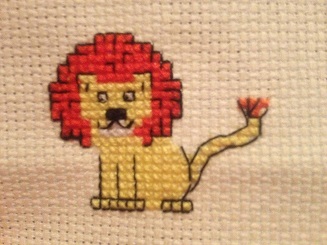
As it happened, this was no problem at all, because she needed to learn to cross stitch a lion.
A craft trio
As we entered the room, Michel spotted me. He beckoned us over to where he sat and said, ‘Good, you’re here … now you can help me remember how to knit!’
And so I came to be part of an inter-generational craft trio that gathered within the Silent Knitting Workshop. I had long known that Michel had knitted as a child. He had told me many times, when we spoke at the same events or shared a stage. And he knew I knitted, because I would quietly knit beside him while others gave their presentations. He had helped to knit socks for French soldiers in the war, he would tell me. So I knew it wouldn’t be hard to help him remember, although I suspected that my grandmother’s chant of ‘in, round, through, and off’ which I learned to recite while making each stitch was probably somewhat different from any French mantra that Michel would have been taught.
It was a fascinating experience to try and help someone remember a hand skill without actually being able to talk to them in any language (because the workshop was Silent). But soon enough Michel was knitting steadily away.
My next task was even harder: trying to teach another hand skill (that of cross stitching a lion) to someone who has no prior experience. Without using any words. While periodically needing to return to help Michel locate the occasional stitch that had been mislaid.

We all got on well though, and at the end of the workshop Michel proudly handed me a piece of multicoloured knitting (still on the needles) as a gift.
I still have it, and it’s in the picture at the top of this blog post.
And on my other side at least half a lion had been beautifully cross stitched. I had probably only spent about a quarter of the time working on my own project, but that was unimportant compared to the satisfaction of having shared my skills, experienced the workshop, and helped facilitate the creation of other masterpieces.
Knitting and birth
The association that Michel made between the repetitive nature of knitting (as practised by the midwife) and the provision of reassurance at birth is worthy of reflection.
I can see how this might help the flow of oxytocin, and have written about such associations myself. Yet I have come to think that this important observation is actually only one tiny element of a far bigger picture.
The quote in the picture above is from an upcoming book, in which I write about the value of knitting, among many other topics.
“Odent (2004) suggested that repetitive tasks are an effective means of reducing tension and that the audible, repetitive clicking of needles can be reassuring (Odent 2008, personal correspondence). If the midwife is knitting, then she or he cannot be too worried about what is happening. Knitting helps keep midwives’ adrenaline levels low, and moves the nervous system into a state of relaxation and safety, ensuring a sense of security all round.” (Wickham, forthcoming.)
Women, craft, and birth
The value of craft comes in many other dimensions and forms as well, and more than one of these might be relevant in relation to birth and midwifery. Not all knitting projects are equally repetitive, and some require far more concentration than might be appropriate for a midwife who needs to also be aware of the birthing woman. Both knitting and many other kinds of craft bring a variety of valuable states of mind, body, and spirit, and we have only really begun to start reflecting on such topics, and on the relationships between women, craft, and birth.
Conversations on this topic – and I use this word in its broadest possible sense, because I understand the value of silence as well – need to continue. But I for one am delighted to have yet another justification for spending more time undertaking and chatting about craft activities.
I’ve been writing about them too!
You’ll find more on this, and many other topics, in my upcoming book on midwifery knowledge.
I’ll be sharing more details in September, and my email subscribers always get the earliest, juiciest, and most extensive details!
If you’re not on my email list and would like to be, sign up here, and then check for the confirmation email.

More knitting resources
I have written another article about knitting, with a couple of colleagues, and a piece on how to knit a baby hat:
Women and birth-related knitting patterns
Here are some of the patterns that I have spotted over the years, for items related to women and birth.
Knitted uterus
Knitted uteruses are very popular. Knitty.com was the source of one of the first knitted uterus patterns I ever found, but I must admit I have never made it. I don’t think it would be much use for birth-related demos, but I love how photogenic it is. One day I’ll make one, to decorate my garden…
I do have one of these plain but very useful uteruses, knitted by my mum, and it works really well for showing the basic principles of cervical dilation and how babies curl up in different positions. There’s a lovely bit of knitted uterus history here.
There are also several smaller versions, some of which even have fallopian tubes and ovaries. We have Ursula Uterus, who was possibly the best post-hysterectomy present ever. Here’s Uttie the stuffed uterus stressball. You might fancy a uterus plushie, or maybe a drawstring bag uterus, which the author suggests keeping tampons in.
Also important are the patterns like this one which include a caesarean scar (and, in this case, can double up as a teaching aid). And the fumin’ womb, an angry uterus designed to protest women’s reproductive rights.
Crochet uterus
If you’d rather crochet than knit, ravelry has a few patterns, including this very cute one by Tink Jones (do click to see the collection of photos sent in by people who have made this pattern in all manner of colours!)
And this one from cuterus (who also lists a few more links, but I think most of them are already in here – worth checking though).
Here’s a crocheted keychain.
Vulva, cervix, and pussy hat knitting patterns
If you’d like more ideas, you could consider Emily’s knitted vulva. Or, possibly not for the faint-hearted, the snatchel from The AntiCraft.
If sewing is more your thing, check out the felt cervix project.
I can’t update this post without including a link to the wonderful pussyhat project!
And finally, next time you’re trying to decide what to make for the woman who has everything, may I humbly suggest a crocheted uterus menstrual cup cozy…
Knitted breasts
Knit for Peace have a couple of free patterns for knitted breasts. As do Lactation Consultants of Great Britain. Here’s the tit bits pattern on knitty.com, and a crocheted breast pattern for those who prefer one needle to two.
Knitted knockers also offer patterns and tutorials. Finally, Ravelry is an absolute treasure trove of patterns. Some are free and some you can buy, which helps creators to find the time it takes to create. Here’s just one example of a popular knitted breast recipe, and, just for fun, a pattern for knitting a breast hat for a baby.
Happy knitting!
photo credit: booties by looseends via photopin cc

About the Author: Dr Sara Wickham is an author, speaker, and researcher specialising in pregnancy, birth and maternity care. Her work focuses on evidence-based, woman-centred information and informed decision-making, drawing on more than 30 years of midwifery knowledge and experience.
Want to stay up to date and get regular updates on birth-related research and thinking sent free to your inbox?
Plus news of Sara’s books, projects, events, and courses?
Sign up to our email newsletter list here
We’ll send you regular, friendly updates to help you keep up-to-date and stay informed.

Books to help you become informed and make the decisions that are right for you…



If this blog post or any of Sara’s work has helped you or those you care for, please buy her a coffee and help us continue to provide independent birth information online as well as in her books.
Thank you.
1 comment for “The value of the knitting midwife”